By Patrick Hardeman– In and Out of Darkness
A smart person can change their mind when new information contradicts what they believed yesterday. An indoctrinated person sees that same information and immediately starts looking for a reason it cannot possibly be true.
That difference matters.
Growth requires us to occasionally admit something painful: I was wrong.
Those might be three of the most difficult words in America. We would rather refinance a bad decision, defend it for seven years, blame three other people and start a podcast explaining why it was actually a brilliant decision than simply admit, “Yeah, I screwed that one up.”
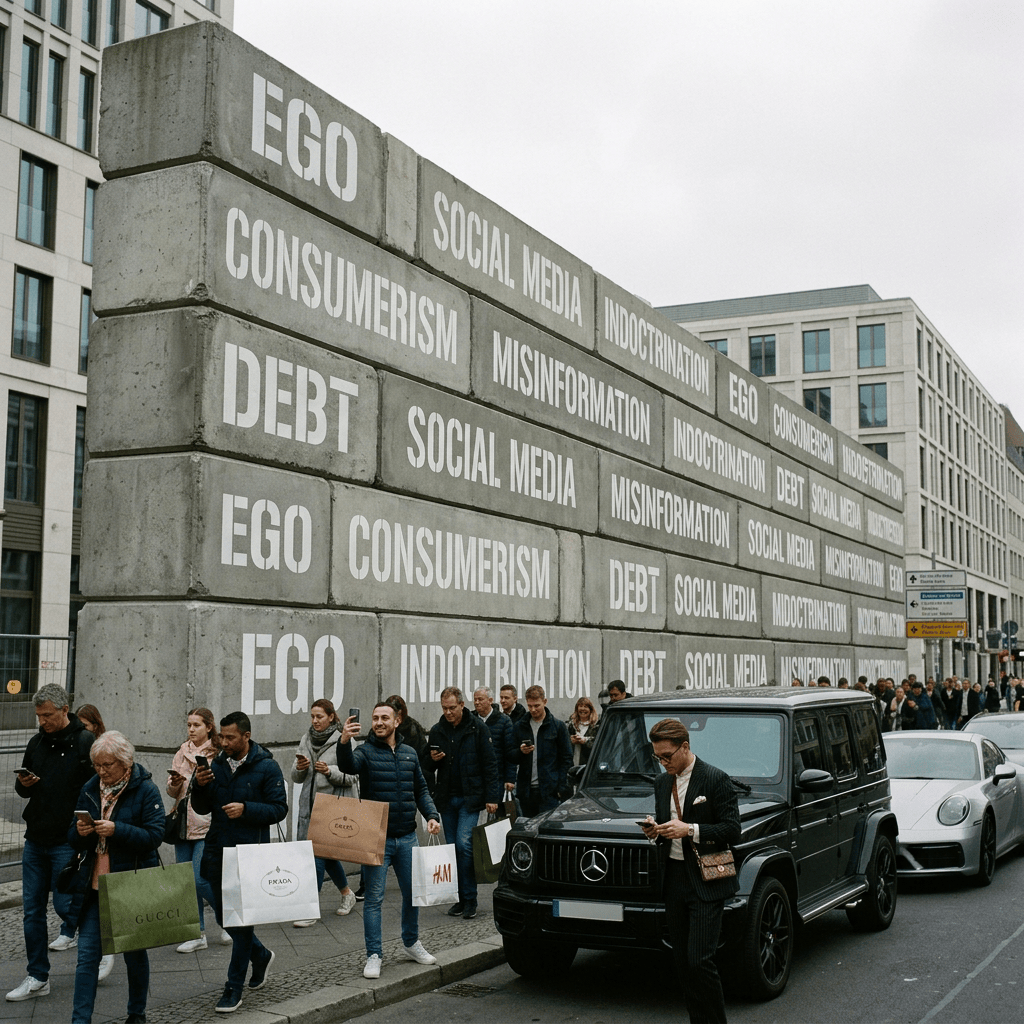
We have built our own Berlin Walls around growth.
Brick by brick, we protect our beliefs, habits, spending, relationships, friendships, acquaintances, politics, parenting, and even our misery. Once something becomes part of our identity, contradictory information doesn’t feel like information anymore. It feels like an attack.
That is when learning stops.
And there may be no better example of this than our relationship with money and consumerism.
Millions of people aren’t buying things because they need them. They are buying an identity. The luxury industry understands this better than most consumers ever will. Status doesn’t have to sit in your bank account anymore. You can wear it on your feet, park it in the driveway, carry it on your shoulder and finance it at an interest rate that should require a hostage negotiator.
We have confused looking wealthy with building wealth.
Those are not remotely the same thing.
A person can drive an $80,000 vehicle and have $400 in savings. Someone else can drive a twelve-year-old Toyota while quietly owning investments, property and a retirement account. Guess which person social media is more likely to convince you is “winning”?
Exactly.
The camera cannot photograph financial security.
It can photograph rims.
That became especially visible during the COVID years. At the same time when the country was facing uncertainty, isolation, job disruptions and fear, shopping became one of the many ways people tried to manufacture a little temporary happiness. Packages kept arriving while peace of mind remained mysteriously backordered.
And that gets to the deeper issue.
Sometimes we aren’t buying the shoes.
We’re buying the feeling we hope comes with the shoes.
We’re buying attention. Validation. Status. Escape. A temporary break from insecurity. Maybe we’re trying to convince strangers that our lives are going wonderfully because convincing ourselves stopped working sometime around Tuesday.
Social media poured gasoline on something consumer culture had already perfected.
Research increasingly connects social-media use with materialism, especially when the experience revolves around comparison. That shouldn’t surprise anyone. Open your phone and within minutes you can find someone younger than you, prettier than you, richer than you, traveling somewhere you aren’t driving something you don’t own and apparently eating brunch on a Wednesday because nobody on Instagram seems to have a damn job.
What you don’t see is the complete financial statement behind the photograph.
You see the vacation, not the credit-cared balance. You see the Mercedes, not the 84-month loan. You see the designer bag, not the emergency saving account sitting at $17.42.
Then comes the algorithm.
Consumerism has become one of our newest colonizers.
It doesn’t need your land.
It wants your attention.
It studies what makes you insecure, what makes you curious, what makes you jealous, what makes you horny, what makes you angry and what keeps your thumb moving upward.
Then it sells access to your attention.
(Which many of us voluntarily give for free!)
The frightening part is how willingly we participate.
We hand our attention, our habits, our interests and our insecurities, and eventually we hand over our money. Then the package arrives and we get a tiny chemical celebration before realizing we are still the same person standing in the same kitchen; except now we own another air fryer.
And social media has created another problem: everybody can become an expert before lunch.
Read two psychology articles and suddenly you’re a relationship therapist. All while being single!
Lose twelve pounds and you’re a nutritionist. (Not mentioning how you used chemicals.)
Make one profitable stock trade and you’re Warren Buffett with a ring light.
Survive one terrible relationship and now you’re teaching 600,000 followers why every disagreement is “narcissistic abuse.”
We consume advice the same way we consume products: quickly, emotionally and often without checking where the hell it came from.
That is dangerous because an unhappy population is extremely profitable.
People who feel complete don’t need to constantly purchase completion.
People comfortable with themselves don’t need strangers to validate every outfit, meal, vacation, relationship and accomplishment. People with purpose are harder to distract because they have somewhere to direct their attention.
And attention my be one of the most valuable currencies we possess.
This doesn’t mean enjoying nice things is wrong. Buy the shoes. Take the vacation. Get the car. I enjoy nice things too. Balance is the point.
There is nothing wrong with owning expensive things.
There is something wrong when expensive things own you.
Too much of almost anything eventually destroys balance. Food. Alcohol. Work. Sex (with multiple partners). Gaming. Shopping. Social media. Even exercise can become destructive when obsession replaces health.
Yet balance becomes much harder when people are miserable.
When parents don’t want to parent, workers feel disposable, families are financially stretched and leadership; especially the government increasingly feels like theater, distraction becomes easier to sell than solutions.
Keep people fighting.
Keep them scrolling.
Keep them shopping.
Keep them comparing.
Keep them convinced that the person struggling beside them is the enemy while somebody much farther up the economic ladder quietly profits from both of them.
That is the Berlin Wall.
And the bricks aren’t made from concrete.
They’re made from ego, insecurity, tribalism, consumerism, misinformation and our absolute refusal to occasionally say:
Maybe I need to rethink this.
Growth begins when we become willing to demolish our own wall.
Ask uncomfortable questions.
Why do I believe this?
Who taught me this?
Who benefits from me continuing to believe it?
Am I buying this because I actually want it, or because I want somebody else to see me with it?
Am I defending this person because they’re right, or because admitting they’re wrong would force me to question myself?
When was the last time new information actually changed my mind?
Those questions aren’t weakness.
They’re evidence that your brain still works.
The original Berlin Wall eventually came down.
Ours can too.
But first we have to stop guarding it.

It’s appreciated if you add a like, subscribe, add a comment, and share this post with others. Then join the conversation, don’t be afraid. There’s plenty more where this came from, so keep scrolling and check out some previous conversations


Don’t forget to be part of the conversation and it’s free to add a like!