By Patrick Hardeman – In and Out of Darkness
There may be no more convenient phrase in America’s racial vocabulary than, “Why can’t Black people just move on?”
Move on from what, exactly? You move on from a bad date, a terrible haircut, or your favorite team destroying your Sunday. But how exactly do you move on from yesterday when yesterday keeps changing clothes and showing up for work Monday morning?
That’s the part America keeps avoiding.
As long as you need sunscreen and or originated from places like Europe: We build museums so nobody forgets certain atrocities. We establish memorials, teach dates to children, hold ceremonies and remind future generations that remembering human suffering is a moral responsibility. And it should be. But mention the historical experiences of Black Americans and suddenly somebody starts checking the clock. That was a long time ago. Why are we still talking about it? Apparently suffering comes with different expiration dates.
Black Americans aren’t demanding that every white person wake up, stare into the bathroom mirror and apologize to Frederick Douglass. Relax. Nobody asked for that. We’re asking for something far more reasonable: tell the truth about what happened, acknowledge what it produced, recognize what continues, and stop pretending today’s scoreboard started at 0-0.
Go back and listen to Black leaders speaking in 1961, 1962, or 1963; not just the famous clips, but the actual conversations. They were talking about economic opportunity, police brutality, voting rights, housing, healthcare, education, banking and equal protection under the law. Now look at the conversations we’re having today.
Same subjects.
At some point we have to admit this isn’t nostalgia. This is the darkest version of Groundhog Day ever produced. Same script, new actors, better cameras.
That’s why telling Black Americans to “move forward” is insulting. We’ve been moving. The treadmill is the problem.
America told Black people to buy property. We did. Build businesses. We did. Educate ourselves. Done. Establish our own institutions and communities. Done. Serve the country. We certainly did that too.
Black farmers once controlled millions upon millions of acres of American farmland. Much of it disappeared across generations through discriminatory lending, violence, legal manipulation, partition sales and government policy. Black Americans created successful commercial districts and communities too. Greenwood in Tulsa became so prosperous it was known as Black Wall Street; until a white mob descended upon it in 1921, killing thousands of people and burning homes and businesses across roughly 35 city blocks.
So when somebody tells Black people, “You should build your own communities,” history occasionally has to clear its throat.
We did.
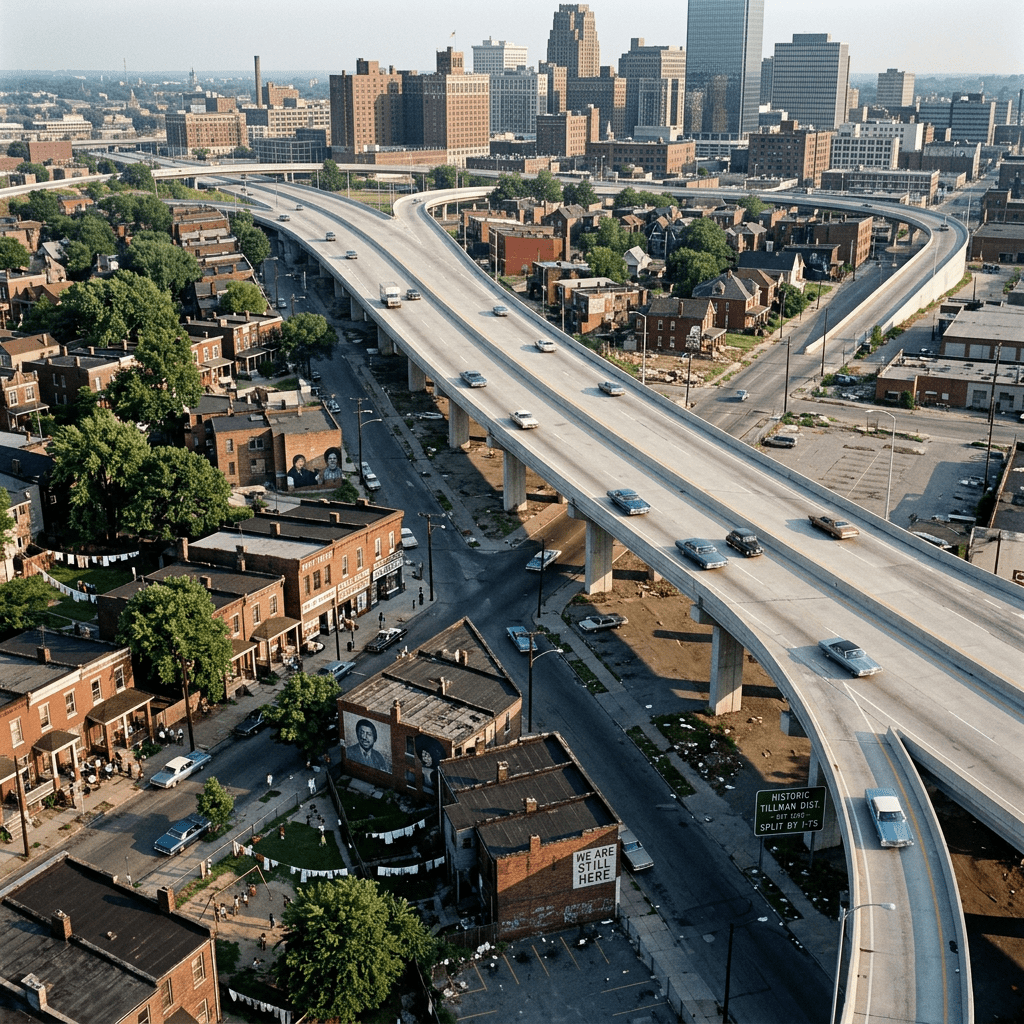
And when fire wasn’t necessary, America discovered concrete.
During the interstate highway era, highways were repeatedly routed through established Black neighborhoods, destroying homes and businesses and splitting communities apart. Miami’s Overtown was devastated by highway construction. Nashville’s I-40 tore through North Nashville. Similar stories played out around the country under the respectable language of “urban renewal.” Another cherished example: Central Park.
So yes, America literally paved over portions of Black prosperity and then generations later asked why Black communities didn’t have more generational wealth.
Somebody may currently be doing 70 miles per hour across part of the answer.
Then comes another favorite lecture: education is the key.
Black America knows. That’s why Historically Black Colleges and Universities exist. HBCUs educated generations of doctors, teachers, scientists, attorneys, military officers, engineers and business leaders when many other institutions wouldn’t even let Black students through the doors. And yes I’m only speaking of less than 60 years ago! Yet in 2023, the federal government calculated that 16 states had underfunded their historically Black land-grant universities by approximately $12.6 billion compared with their predominantly white counterparts over roughly three decades.
We were told education was the road forward. We built the schools, filled the classrooms and produced excellence. Then the institutions were denied billions in equitable funding.
You cannot keep removing the bricks from somebody’s house and then criticize the architecture.
This same selective morality appears in how Black suffering is received. Before Black pain can simply be acknowledged, it frequently has to survive an interrogation: What did he do? Was he complying? Why was she there? Was that really racism? Why make everything about race? Why are you so angry?
At some point Black pain needs its own attorney just to enter the conversation.
And perhaps one of the strangest parts of America’s racial culture is how quickly people from elsewhere can learn its hierarchy without bothering to learn its history. Someone can know almost nothing about Reconstruction, redlining, sundown towns, racial covenants, Black land loss, discriminatory lending or urban renewal and somehow become an expert on what Black Americans should stop complaining about.
That’s impressive.
Wrong as hell, but impressive.
That includes an uncomfortable conversation about representation. Blackness is not one universal historical experience. Someone from London, Lagos, Kingston, Accra or Paris can absolutely experience anti-Black racism, but that doesn’t make their historical experience identical to Black Americans whose families endured America’s particular systems of slavery, Reconstruction, Jim Crow, racial terror, segregation and everything constructed around them afterward.
This isn’t xenophobia. it’s history.
Hollywood, politics and media can cast or hire whoever they choose, but putting a Black face in a position doesn’t automatically mean the Black American experience is being represented or even understood. Melanin is not a downloadable American history degree. If you’re going to confidently explain what Black Americans should “move on” from, learning what actually happened should at least be the admission price.
Then comes the puppet-friendly phrase from outside and inside the community: Especially from those few token members of our community, who are rewarded to publicly say “Aren’t we over kneeling…” and or “do you have that red hat of hate in my size…?”
“How do we move the conversation forward?”
Forward to where?
We’ve been having versions of the same conversation for generations because a past cannot be properly adjudicated until it is first accepted as reality. You cannot reconcile what you refuse to acknowledge, repair what you’re forbidden from examining, or demand that the injured party move on while simultaneously arguing that the injury wasn’t that serious.
And this isn’t about assigning every modern racial disparity to one cause or blaming every living white American for something somebody else did generations ago. That’s a lazy escape hatch. I know of plenty of amazing white Americans.
The actual point is that history creates conditions.
Property becomes inheritance. Inheritance becomes capital. Capital creates opportunity. Opportunity builds networks and influence, and influence helps protect the system that produced it.
The opposite works too.
Take property. Destroy businesses. Restrict lending. Segregate neighborhoods. Underfund institutions. Block opportunities. Wait a few generations, point at the resulting inequality and call it a cultural failure.
That’s not analysis.
That’s historical money laundering.
Black America has been moving forward the entire time. We fought in America’s wars, bought land, created businesses, established institutions, entered universities and became doctors, professors, generals, judges, scientists, entrepreneurs and elected officials. We survived laws designed to exclude us, or just end our lives. Then excelled inside institutions that once prohibited us from entering the building.
So perhaps the better question isn’t why Black Americans won’t move on.
Ask why Black progress has so often been answered with resistance, destruction, extraction, relocation, defunding and then historical amnesia of white America’s need for violence; while labelling anyone else thugs.
There are events, and then there are cycles. Breaking a cycle requires acknowledging that it exists.
You don’t cure an infection by becoming offended at the X-ray. You don’t repair a foundation by outlawing conversations about the cracks. And you cannot keep asking millions of people why they’re discussing the past when conversations from 1963 are still sitting at the kitchen table in 2026.
Black America doesn’t need permission to move forward. We’ve been moving.
Remembering who moved the finish line isn’t refusing to run.
And knowing your history isn’t living in the past.
Sometimes it’s the only damn way to recognize when the past has followed you home. Never Forget!

It’s appreciated if you add a like, subscribe, add a comment, and share this post with others. Then join the conversation, don’t be afraid. There’s plenty more where this came from, so keep scrolling and check out some previous conversations


 In and Out of Darkness
Don’t forget to be part of the conversation and it’s free to add a like!