
By Patrick Hardeman – In and Out of Darkness
America has always loved a Good badge. Wealth is a badge. A prestigious degree is a badge. A political title is definitely a badge, and apparently if you collect enough of them, we’re all supposed to assume competence came inside the package. So today, in the spirit of old-school Sesame Street, we’re going to learn the difference between looking qualified and actually being good at your job. Because somewhere between Harvard, Yale, Princeton, MIT, Stanford, Columbia, the University of Chicago, UC Berkeley, Johns Hopkins and plenty more, this country created an impressive collection of highly educated people who can explain almost anything; except why the nation they’re helping manage keeps producing the same expensive problems.
Let’s be clear: education isn’t the enemy. Knowledge matters. Expertise matters. But a diploma tells me where you studied; results tell me whether you learned anything useful. America constantly bombards us with the résumés of people holding positions of enormous responsibility: Congress, Treasury, the Federal Reserve, courts, attorneys, agency directors, economists and policy advisers. I would add the President to that traditional parade of prestigious credentials, but our current one seems educated through the School of Scoundrels and Hate. We’re introduced to their degrees, fellowships, previous appointments and prestigious connections as though somebody is reading the starting lineup for the intellectual Olympics. Fine. Now show me the scoreboard. The United States is carrying more than $38 trillion in gross national debt, communities are struggling with homelessness and addiction, healthcare can financially cripple families, housing is increasingly unaffordable, infrastructure is aging, and racial inequities created over generations remain unresolved. That is one hell of a group project for this many geniuses.
What’s fascinating is how quickly accountability changes depending upon where someone sits on the economic ladder. Poor people are irresponsible. Homeless people made bad choices. Black communities need to fix themselves. Working families need to budget better. Young people need to stop complaining. Yet when enormously powerful institutions repeatedly produce terrible outcomes, suddenly everybody becomes a philosopher: Well, it’s complicated. Of course it’s complicated. So is being poor. So is raising children without enough money. So is recovering from addiction. So is choosing between medicine and rent. Complexity shouldn’t become an escape hatch reserved for powerful people while everyone underneath them gets beaten over the head with “personal responsibility.”
Welcome to designer incompetence: failure, but tailored. Imagine managing a warehouse where inventory disappears, expenses explode, equipment breaks, employees quit and customers are furious. Your boss probably isn’t going to shake your hand and say, Outstanding work, Jane, John. Here’s another six-year term. In ordinary employment, eventually somebody asks whether you’re actually capable of performing the job. Yet government has developed the remarkable ability to separate performance from continued employment. Politicians blame the other party. Agencies blame funding. Administrations blame previous administrations, previous administrations blame current administrations, and eventually somebody wearing a $2,000 suit appears on television to explain why you need to tighten your belt.
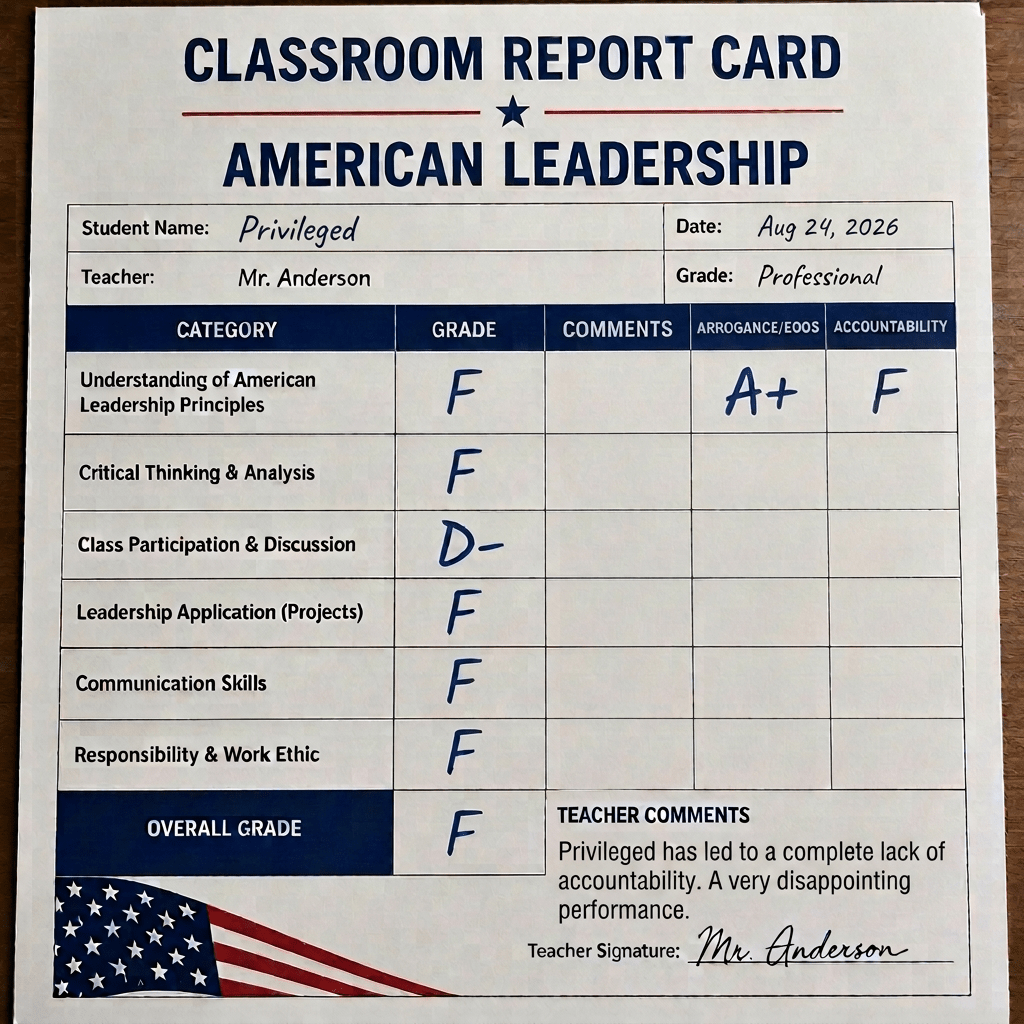
This is where prestige becomes dangerous. If the same institutions repeatedly credential the people who design, justify, manage and evaluate public policy, at what point does prestige stop being evidence of competence and become protection from accountability? There is no shortage of people willing to weaponize their education and demand additional respect because of the degrees they’ve accumulated. Congratulations. Stroke your own ego. The rest of us don’t owe anyone a kiss on the ring because they successfully navigated academia. If your city, institution, community or area of responsibility is measurably worse after years under your leadership, perhaps the public shouldn’t be mesmerized by the Latin written across your diploma.
And then there’s ethics, America’s favorite disappearing act. Universities teach ethics in business, medicine, law, research and public policy, yet somewhere between graduation and acquiring power, the textbook apparently falls out of the moving limousine. And Pandora’s box isn’t merely cracked anymore; America busted the hinges off. The country elected Donald Trump president not once, but twice, despite his criminal convictions and a civil jury finding him liable for sexual abuse. Whatever anyone’s political affiliation, consider the standard that establishes. Millions of ordinary Americans can lose employment opportunities over criminal records or conduct far less consequential, while the most powerful job in the nation can apparently operate under a dramatically different entrance exam. When power itself becomes negotiable, don’t lecture the powerless about morality.
And we shouldn’t pretend younger generations aren’t watching. America cannot demonstrate repeatedly that money, popularity and power can overpower character, we shouldn’t act confused when younger generations study the blueprint. If the lesson from the highest levels of society becomes win first, ethics later, why would we expect children to believe the ethics lecture? Children are excellent students. Adults just keep teaching some terrible lessons.
That’s why I believe enormous public responsibility should come with something ordinary Americans already understand: probation and performance standards. When normal people are hired, expectations are established. Their work is evaluated. If they consistently cannot perform essential responsibilities, somebody else eventually gets the opportunity. Why should greater responsibility require less accountability? I’m not suggesting cities or countries can be reduced to one magical spreadsheet, because leaders inherit circumstances they didn’t create and governments are complex. But complexity doesn’t make measurement impossible. Housing, infrastructure, public safety, education, health, debt, constituent services, government efficiency and ethics can all be evaluated according to what a particular office can realistically influence.
And publish those results in language normal human beings can understand. Not campaign commercials. Not donor-funded applause. Not carefully edited social-media clips. Not a 97-page report requiring three economists, a lawyer and an Ouija board to understand it. Did conditions improve or didn’t they? Public officials should have defined benchmarks, meaningful performance reviews and genuine consequences for sustained failure. Concentrated political power service wasn’t supposed to become ownership of a chair until someone is wheeled away from it.
The universities producing and celebrating America’s leadership class shouldn’t escape examination either. If an elite institution proudly advertises its graduates when they become senators, judges, economists, executives, and cabinet officials, society has every right to examine the consequences of their leadership. You can’t hang someone’s picture on the wall when they succeed and suddenly develop amnesia when they help design catastrophe. Education shouldn’t merely manufacture impressive résumés; it should help produce sound judgment. And privilege should create more responsibility, not less.
That’s the part America keeps getting backward. We punish failure hardest at the bottom while cushioning it at the top. But what’s worse than someone poor and failing? Someone privileged, enormously empowered and creating waves of failure affecting millions of people. A struggling person may damage their own household. An incompetent person entrusted with tremendous power can damage communities, economies and generations; and still somehow leave office with a book deal.
So no, I won’t. automatically celebrate your title. I don’t care whether your university has ivy climbing the walls, your office has marble floors or important people recognize your last name at dinner. I’ll celebrate when your responsibility produces something worth celebrating. Repair the damage. Improve the city. Strengthen the institution. Make communities healthier. Make people safer. Leave whatever you were trusted with better than you found it. And when you fail, don’t immediately search for somebody poorer, darker, younger or less connected to blame.
Perhaps America’s greatest shortage isn’t intelligence after all. Maybe it’s something far simpler: consequences for intelligent people who repeatedly fail.
Today’s episode was brought to you by the letter A.
A is for Accountability.
And unlike legacy admission, everybody should have to earn a passing grade.
It’s appreciated if you add a like, subscribe, add a comment, and share this post with others. Then join the conversation, don’t be afraid. There’s plenty more where this came from, so keep scrolling and check out some previous conversations


Don’t forget to be part of the conversation and it’s free to add a like!